|
— By Larry Dablemont
Globe columnist
In the early 1980s, Tom Reynolds was coming to Norfork Lake as often as possible
to fish for stripers.
He recalls that he would catch some nice fish and come in to find people who
were unable to catch anything, so he’d take them out and show them how to catch
some. He is still teaching fishermen to catch stripers, and he’s pretty good at
it.
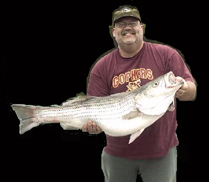
I fished with him last Tuesday morning, and landed the biggest striper I ever
caught.
The amazing thing was, I didn’t catch it on a heavy, stiff rod. I landed that
15-pound fish on a ten-foot light-action spinning rod with only eight-pound
line. We were drifting along not far from the bank, over 12 to 14 feet of water
when the striper hit, and he headed out into deeper water.
It’s a striper’s nature to do that, thank
goodness. If they went for the shallows and looked for something to hide under,
I don’t know how you would ever land one. But since they are a fish of big open
water, they strip line against the drag, take 30 or 40 yards of it and let you
wear them down. They give you a pretty good tussle. A striped bass is a long way
from what Ozarkians have long thought of as a fish. They aren’t native. They are
a sea species which run up into fresh-water rivers to spawn, and back when South
Carolina’s Santee-Cooper reservoirs were created in 1941, the gates were closed
on thousands of stripers, spawning up the river systems which fed the lakes.
Biologists didn’t figure much would come of it, but the stripers thrived, and
took over. Anglers started catching a few of them, and there was some natural
reproduction continuing, so striper fishing became a Southeastern craze. Other
states to the west began to obtain fingerlings and the salt water striper became
adapted to Southern and Midwestern reservoirs, the trophy fish everyone wanted
to catch.
Occasionally the stripers find a way to spawn in those reservoirs, but to do so
they must have many miles of flowing river for the eggs to roll along in. I’ve
heard biologists say they think successful spawns occur in the Norfork River
when it floods just at the right time in the spring, with only eight or ten
miles of river to use.
Reynolds says he thinks it takes more like 40 miles of river. He also says that
stripers in Norfork are about 20 inches long by the time they reach two years of
age, and therefore the 20-inch length limit on Norfork is just perfect. Mature
spawning stripers are about 22 to 24 inches long, and many of them will die when
hooked in deep water and released. Immature stripers will almost always survive
when they are released.
I landed a dozen or so stripers this week which were all better than five
pounds. I kept a 10-pounder and a 15-pounder, but the real prize was a 10-pound
hybrid. Hybrids were created by crossing a white bass male with a striper
female, and the result is a fish which seldom exceeds 20 pounds, but outfights
them all. Stripers in the Ozarks commonly reach 30 pounds or better, and
uncommonly reach 50 pounds. A couple of weeks ago, a 55-incher was taken on
Norfork which Tom figures would be close to 50 pounds. My 15-pounder was 35
inches long, and until we got him in the boat, I was thinking 20 pounds or
better. When you are fighting a big fish on that long, light rod, you just can’t
tell. The fish bend it over and flatten it out, and you spend much of your time
letting them take line, and then trying to pump them back and wear them down.
Until you have caught a big striper or hybrid, you can’t really believe what a
powerful fish they are. And with Reynolds during the spring, a fisherman has
almost no chance of not catching several big fish. We were catching them all
morning, and even caught several at noon. I fish Norfork on occasion with rogue
lures, mostly at night, and catch stripers that way, but it is more work than
Reynolds’ way. He has a big boat, drifts shad along beside it, and you sit back
in a chair watching rods in rod-holders, grabbing whichever one gets bent over
by a striking fish. At one time, we had two fish on at once.
I enjoy fishing with Tom Reynolds. I have fished with him before and look
forward to it because he is the kind of guy you’d like to have come to your
place for dinner. He helps, he teaches, he doesn’t find fault with those who
have little experience. In general, he is a patient, fun-loving fisherman.
Reynolds has plenty of openings in the spring, before the summer fishermen show
up. He can take a group of three or four fishermen at a time, and that makes his
rates very affordable. Call him at (877) 246-4896, or visit his Web site
www.stroutfitters.com if you are interested in a striper fishing trip on
Norfork.
Address correspondence to Larry Dablemont, Box 22, Bolivar, Mo., 65613. Send
e-mail to lightninridge@alltel.net, check the Web site www.larrydablemont.com,
or call (417) 777-5227.
Copyright © 1999-2006 cnhi, inc.
|